

1 Qt How Many Pints
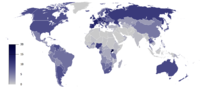
Purposeful production of alcoholic drinks is mutual and often reflects cultural and religious peculiarities as much as geographical and sociological atmospheric condition.
Discovery of tardily Stone Age jugs propose that intentionally fermented beverages existed at to the lowest degree every bit early as the Neolithic catamenia (c. ten,000 BC).[2]
Archaeological record [edit]
The ability to metabolize alcohol likely predates humanity with primates eating fermenting fruit.[3]
The oldest verifiable brewery has been found in a prehistoric burial site in a cave near Haifa in modernistic-day Israel. Researchers have plant residue of 13,000-yr-quondam beer that they think might have been used for ritual feasts to honour the dead. The traces of a wheat-and-barley-based alcohol were establish in stone mortars carved into the cavern flooring.[4] Some have proposed that alcoholic drinks predated agriculture and it was the desire for alcoholic drinks that lead to agriculture and civilization.[5]
As early as 7000 BC, chemical analysis of jars from the Neolithic village Jiahu in the Henan province of northern Cathay revealed traces of a mixed fermented beverage. According to a study published in the Proceedings of the National Academy of Sciences [6] in December 2004,[7] chemical analysis of the residue confirmed that a fermented drink fabricated of grapes, hawthorn berries, honey, and rice was being produced in 7000–6650 BC.[8] [ix] This is approximately the fourth dimension when barley beer and grape wine were get-go to be made in the Middle East.
Evidence of alcoholic beverages has as well been found dating from 5400 to 5000 BC in Hajji Firuz Tepe in Islamic republic of iran,[10] 3150 BC in ancient Egypt,[11] 3000 BC in Babylon,[12] 2000 BC in pre-Hispanic United mexican states[12] and 1500 BC in Sudan.[13] According to Guinness, the earliest house evidence of wine production dates dorsum to 6000 BC in Georgia.[10] [14]
The medicinal utilize of alcohol was mentioned in Sumerian and Egyptian texts dating from about 2100 BC. The Hebrew Bible recommends giving alcoholic drinks to those who are dying or depressed, so that they can forget their misery (Proverbs 31:6–seven).
In 55 BC the Romans took find of an alcoholic cider being made in Britain using native apples, it quickly became popular and was imported back to the continent where it spread rapidly. People in Northern Spain were making cider around the aforementioned time period.[15] [16] Celtic people were known to have been making types of alcoholic cider as early every bit 3000 BC.[17] [18]
Vino was consumed in Classical Greece at breakfast or at symposia, and in the 1st century BC information technology was part of the nutrition of most Roman citizens. Both the Greeks and the Romans by and large drank diluted wine (the force varying from ane part wine and 1 part water, to 1 role wine and 4 parts h2o).[ citation needed ]
In Europe during the Middle Ages, beer, often of very low strength, was an everyday drinkable for all classes and ages of people. A document from that time mentions nuns having an assart of six pints of ale each day.[ citation needed ] Cider and pomace wine were also widely available; grape wine was the prerogative of the higher classes.[ citation needed ]
Past the time the Europeans reached the Americas in the 15th century, several native civilizations had developed alcoholic beverages. According to a post-conquest Aztec document, consumption of the local "vino" (pulque) was mostly restricted to religious ceremonies only was freely allowed to those who were older than 70 years.[xix] The natives of South America produced a beer-like beverage from cassava or maize, which had to be chewed earlier fermentation in order to turn the starch into carbohydrate (beverages of this kind are known today as cauim or chicha). This chewing technique was likewise used in aboriginal Japan to brand sake from rice and other starchy crops.[ commendation needed ]
Ancient period [edit]
Ancient China [edit]
The primeval evidence of wine was found in what is at present Prc, where jars from Jiahu which date to about 7000 BC were discovered. This early on rice wine was produced past fermenting rice, beloved, and fruit.[20] What later developed into Chinese civilization grew upwardly forth the more northerly Yellow River and fermented a kind of huangjiu from millet. The Zhou attached great importance to alcohol and ascribed the loss of the mandate of Sky by the earlier Xia and Shang as largely due to their dissolute and alcoholic emperors. An edict ascribed to c. 1116 BC makes it clear that the use of alcohol in moderation was believed to exist prescribed by sky.
Different the traditions in Europe and the Eye East, Red china abandoned the product of grape wine before the advent of writing and, under the Han, abandoned beer in favor of huangjiu and other forms of rice wine. These naturally fermented to a strength of most 20% ABV; they were usually consumed warmed and ofttimes flavored with additives as part of traditional Chinese medicine. They considered it spiritual food and all-encompassing documentary testify attests to the important role it played in religious life. "In ancient times people always drank when holding a memorial ceremony, offering sacrifices to gods or their ancestors, pledging resolution before going into battle, celebrating victory, before feuding and official executions, for taking an oath of allegiance, while attending the ceremonies of birth, marriage, reunions, departures, death, and festival banquets."[ commendation needed ] Marco Polo's 14th century record indicates grain and rice wine were drunk daily and were one of the treasury's biggest sources of income.
Alcoholic beverages were widely used in all segments of Chinese society, were used as a source of inspiration, were important for hospitality, were considered an antidote for fatigue, and were sometimes misused. Laws against making wine were enacted and repealed forty-one times between 1100 BC and AD 1400. Withal, a commentator writing around 650 BC asserted that people "will not practise without beer. To prohibit it and secure total abstinence from it is beyond the power even of sages. Hence, therefore, we have warnings on the abuse of it."[21]
The Chinese may accept independently developed the process of distillation in the early centuries of the Common Era, during the Eastern Han dynasty.[22]
Ancient Persia (or Ancient Iran) [edit]
A major step frontwards in our understanding of Neolithic winemaking came from the analysis of a yellowish residue excavated by Mary M. Voigt at the site of Hajji Firuz Tepe in the northern Zagros Mountains of Iran. The jar that once contained wine, with a volume of nigh 9 liters (2.v gallons) was found together with five similar jars embedded in the earthen floor along 1 wall of a "kitchen" of a Neolithic mudbrick building, dated to c. 5400–5000 BC.[8] [23] In such communities, winemaking was the best technology they had for storing highly perishable grapes, although whether the resulting drinkable was intended for intoxication every bit well as nourishment is not known.[8]
Ancient Egypt [edit]
Brewing dates from the beginning of civilization in ancient Egypt, and alcoholic beverages were very of import at that time. Egyptian brewing began in the city of Hierakonpolis around 3400 BC; its ruins contain the remains of the world'south oldest brewery, which was capable of producing up to iii hundred gallons (1,136 liters) per day of beer.[eight] Symbolic of this is the fact that while many gods were local or familial, Osiris was worshiped throughout the entire land. Osiris was believed to be the god of the dead, of life, of vegetable regeneration, and of wine.[8] [21] [24]
Both beer and wine were deified and offered to gods. Cellars and wine presses even had a god whose hieroglyph was a winepress. The ancient Egyptians fabricated at to the lowest degree 17 types of beer and at least 24 varieties of wine. The nigh mutual blazon of beer was known as hqt. Beer was the drink of mutual laborers; financial accounts report that the Giza pyramid builders were allotted a daily beer ration of one and ane-third gallons.[8] Alcoholic beverages were used for pleasure, diet, medicine, ritual, remuneration, and funerary purposes. The latter involved storing the beverages in tombs of the deceased for their utilize in the afterwards-life.
Numerous accounts of the menstruation stressed the importance of moderation, and these norms were both secular and religious. While Egyptians did not generally announced to define drunkenness as a trouble, they warned against taverns (which were often houses of prostitution) and excessive drinking. After reviewing extensive testify regarding the widespread but by and large moderate use of alcoholic beverages, the nutritional biochemist and historian William J. Darby makes a most important observation: all these accounts are warped by the fact that moderate users "were overshadowed by their more than boisterous counterparts who added 'color' to history." Thus, the intemperate use of alcohol throughout history receives a disproportionate amount of attention. Those who excessively use booze cause problems, draw attending to themselves, are highly visible and cause legislation to be enacted. The vast majority of drinkers, who neither feel nor cause difficulties, are not noteworthy. Consequently, observers and writers largely ignore moderation.[21]
Evidence of distillation comes from alchemists working in Alexandria, Roman Arab republic of egypt, in the 1st century AD.[25] Distilled h2o has been known since at to the lowest degree c. 200 Advertising, when Alexander of Aphrodisias described the process.[26]
Ancient Babylon [edit]
Beer was the major beverage amid the Babylonians, and as early on as 2700 BC they worshiped a wine goddess and other wine deities. Babylonians regularly used both beer and vino as offerings to their gods. Around 1750 BC, the famous Code of Hammurabi devoted attention to booze. However, at that place were no penalties for drunkenness; in fact, information technology was not even mentioned. The concern was fair commerce in booze. Although information technology was non a crime, the Babylonians were disquisitional of drunkenness.[ citation needed ]
Ancient India [edit]
Alcohol distillation likely originated in Republic of india.[27] Alcoholic beverages in the Indus Valley civilization appeared in the Chalcolithic Era. These beverages were in use between 3000 BC and 2000 BC. Sura, a beverage brewed from rice meal, wheat, saccharide pikestaff, grapes, and other fruits, was popular amid the Kshatriya warriors and the peasant population.[28] Sura is considered to be a favorite drink of Indra.[29]
The Hindu Ayurvedic texts describe both the beneficent uses of consuming alcoholic beverages and the consequences of intoxication and alcoholic diseases. Ayurvedic texts concluded that booze was a medicine if consumed in moderation, but a poison if consumed in excess.[29] Most of the people in India and China, have continued, throughout, to ferment a portion of their crops and attend themselves with the alcoholic product.
In aboriginal India, alcohol was besides used past the orthodox population. Early Vedic literature suggests the use of alcohol by priestly classes.[30]
The ii bang-up Hindu epics, Ramayana and Mahabharata, mention the apply of alcohol. In Ramayana, alcohol consumption is depicted in a expert/bad dichotomy. The bad faction members consumed meat and alcohol while the practiced faction members were abstemious vegetarians. Even so, in Mahabharata, the characters are not portrayed in such a black-white contrast.[31]
Alcohol abstinence was promoted as a moral value in Republic of india by Mahavira, the founder of Jainism, and Adi Shankaracharya.[30]
Distillation was known in the aboriginal Indian subcontinent, evident from broiled clay retorts and receivers found at Taxila and Charsadda in mod Pakistan, dating back to the early on centuries of the Common Era. These "Gandhara stills" were only capable of producing very weak liquor, as in that location was no efficient means of collecting the vapors at low heat.[32]
Ancient Greece [edit]
While the art of wine making reached the Hellenic peninsula by about 2000 BC, the first alcoholic beverage to obtain widespread popularity in what is now Hellenic republic was mead, a fermented potable made from dearest and water. However, by 1700 BC, vino making was commonplace. During the adjacent thousand years wine drinking assumed the aforementioned function and then commonly found around the world: It was incorporated into religious rituals. It became of import in hospitality, used for medicinal purposes, and became an integral office of daily meals. Equally a drink, it was drunk in many means: warm and chilled, pure and mixed with water, manifestly and spiced.[21] Booze, specifically wine, was considered and so important to the Greeks that consumption was considered a defining characteristic of the Hellenic culture between their society and the rest of the world; those who did not drink were considered barbarians.[8]
While habitual drunkenness was rare, intoxication at banquets and festivals was not unusual. In fact, the symposium, a gathering of men for an evening of conversation, entertainment and drinking typically concluded in intoxication. Notwithstanding, while there are no references in ancient Greek literature to mass drunkenness among the Greeks, there are references to it among foreign peoples. By 425 BC, warnings confronting intemperance, especially at symposia, appear to become more frequent.[21]
Xenophon (431–351 BC) and Plato (429–347 BC) both praised the moderate employ of wine as benign to health and happiness, but both were disquisitional of drunkenness, which appears to accept become a problem. Plato also believed that no ane under the age of eighteen should be allowed to touch on wine. Hippocrates (cir. 460–370 BC) identified numerous medicinal properties of wine, which had long been used for its therapeutic value. Subsequently, both Aristotle (384–322 BC) and Zeno (cir. 336–264 BC) were very critical of drunkenness.[21]
Among Greeks, the Macedonians viewed intemperance as a sign of masculinity and were well known for their drunkenness. Their rex, Alexander the Great (356–323 BC), whose mother adhered to the Dionysian cult, developed a reputation for inebriety.[21]
Pre-Columbian America [edit]
Several Native American civilizations developed alcoholic beverages. Many versions of these beverages are still produced today.

Pulque , or octli is an alcoholic beverage fabricated from the fermented juice of the maguey, and is a traditional native beverage of Mesoamerica.[34] Though commonly believed to exist a beer, the main sugar is a circuitous form of fructose rather than starch. Pulque is depicted in Native American stone carvings from equally early as AD 200. The origin of pulque is unknown, merely because information technology has a major position in religion, many folk tales explain its origins.[35]
Balché is the name of a honey vino brewed by the Maya. The drink shares its proper noun with the balché tree (Lonchocarpus violaceus), the bark of which is fermented in water together with honey from the indigenous stingless bee.[36]
Tepache is a mildly alcoholic beverage ethnic to United mexican states that is created past fermenting pineapple, including the rind, for a short period of three days.[37]
Tejuino , traditional to the Mexican state of Jalisco, is a maize-based potable that involves fermenting masa dough.
Chicha is a Spanish word for any of variety of traditional fermented beverages from the Andes region of South America. Information technology can exist fabricated of maize, manioc root (also chosen yuca or cassava) or fruits amid other things.[38] During the Inca Empire women were taught the techniques of brewing chicha in Acllahuasis (feminine schools). Chicha de jora is prepared by germinating maize, extracting the malt sugars, boiling the wort, and fermenting it in large vessels, traditionally huge earthenware vats, for several days. In some cultures, in lieu of germinating the maize to release the starches, the maize is basis, moistened in the chicha maker's mouth and formed into small balls which are so flattened and laid out to dry. Naturally occurring diastase enzymes in the maker'due south saliva catalyze the breakdown of starch in the maize into maltose. Chicha de jora has been prepared and consumed in communities throughout in the Andes for millennia. The Inca used chicha for ritual purposes and consumed it in vast quantities during religious festivals. In recent years, however, the traditionally prepared chicha is becoming increasingly rare. Only in a small number of towns and villages in southern Peru and Bolivia is it still prepared. Other traditional drinks made from fermented maize or maize flour include pozol and pox.[39]
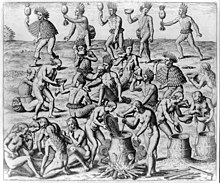
Manioc root being prepared by Indian women to produce an alcoholic drink for ritual consumption, by Theodor de Bry, Frankfurt, 1593. Women in the lower left tin be seen spitting into the manioc mash. Salivary enzymes suspension downward complex starches, and saliva introduces bacteria and yeast that hasten the fermentation process.
Cauim is a traditional alcoholic potable of the Native American populations of Brazil since pre-Columbian times. It is however made today in remote areas throughout Panama and South America. Cauim is very similar to chicha and it is also made by fermenting manioc or maize, sometimes flavored with fruit juices. The Kuna Indians of Panama use plantains. A feature characteristic of the beverage is that the starting textile is cooked, chewed, and re-cooked prior to fermentation. As in the making of chicha, enzymes from the saliva of the cauim maker intermission downward the starches into fermentable sugars.
Tiswin , or niwai is a mild, fermented, ceremonial beverage produced by various cultures living in the region encompassing the southwestern United States and northern United mexican states. Among the Apache, tiswin was made from maize, while the Tohono O'odham brewed tiswin using saguaro sap.[forty] The Tarahumara variety, chosen tesgüino , tin can be made from a variety of different ingredients. Recent archaeological evidence has also revealed the production of a similar maize-based intoxicant among the ancestors of the Pueblo peoples.[41] [42]
Cacao vino was produced during the formative phase of the Olmec Civilisation (1100–900 BC). Testify from Puerto Escondido indicates that a weak alcoholic beverage (up to 5% alcohol by volume) was made from fermented cacao pulp and stored in pottery containers.[43] [44]
In addition:
- The Iroquois fermented sap from the saccharide maple tree to produce a mildly alcoholic beverage.[45]
- The Chiricahua prepared a kind of corn beer called tula-pah using sprouted corn kernels, stale and ground, flavored with locoweed or lignum vitae roots, placed in water and immune to ferment.[46]
- The Coahuiltecan in Texas combined mountain laurel with agave sap to create an alcoholic drink similar to pulque.[47]
- The Zunis made fermented beverages from aloe, maguey, corn, prickly pear, pitaya and grapes.[48]
- The Creek of Georgia and Cherokee of the Carolinas used berries and other fruits to make alcoholic beverages.[49]
- The Huron fabricated a mild beer by soaking corn in water to produce a fermented gruel to exist consumed at tribal feasts.[47]
- The Kwakiutl of Vancouver Island produced a mildly alcoholic drink using elder juice, blackness chitons, and tobacco.[50]
- Both the Aleuts and Yuit of Kodiak Island in Alaska were observed making alcoholic drinks from fermented raspberries.[49]
Ancient Rome [edit]
Bacchus, the god of vino –for the Greeks, Dionysus– is the patron deity of agriculture and the theater. He was also known as the Liberator (Eleutherios), freeing one from 1'south normal self, by madness, ecstasy, or wine. The divine mission of Dionysus was to mingle the music of the aulos and to bring an end to care and worry. The Romans would concord dinner parties where wine was served to the guest all day forth with a iii course feast. Scholars have discussed Dionysus' relationship to the "cult of the souls" and his ability to preside over communication between the living and the dead.
The Roman belief that wine was a daily necessity made the drink "autonomous" and ubiquitous: wine was bachelor to slaves, peasants, women and aristocrats akin. To ensure the steady supply of vino to Roman soldiers and colonists, viticulture and wine production spread to every part of the empire. The Romans diluted their vino before drinking. Vino was as well used for religious purposes, in the pouring of libations to deities.
Though beer was drunk in Ancient Rome, it was replaced in popularity by wine.[51] Tacitus wrote disparagingly of the beer brewed past the Germanic peoples of his mean solar day. Thracians were also known to swallow beer fabricated from rye, even since the 5th century BC, as the ancient Greek logographer Hellanicus of Lesbos says. Their proper noun for beer was brutos, or brytos. The Romans called their brew cerevisia, from the Celtic discussion for it. Beer was plain enjoyed by some Roman legionaries. For example, among the Vindolanda tablets (from Vindolanda in Roman Britain, dated c. 97–103 Advertizing), the cavalry decurion Masculus wrote a letter to prefect Flavius Cerialis inquiring most the exact instructions for his men for the following day. This included a polite request for beer to exist sent to the garrison (which had entirely consumed its previous stock of beer).[52]
Ancient Sub-Saharan Africa [edit]
Palm wine played an important social role in many African societies.
Sparse, gruel-like, alcoholic beverages have existed in traditional societies all across the African continent, created through the fermentation of sorghum, millet, bananas, or in modern times, maize or cassava.[53]
Ancient Polynesia [edit]
Okolehao is produced past Native Hawaiians from juice extracted from the roots of the ti establish.[54]
Medieval menstruation [edit]
Medieval Middle Eastward [edit]
Medieval Muslim chemists such equally Jābir ibn Ḥayyān (Latin: Geber, 9th century) and Abū Bakr al-Rāzī (Latin: Rhazes, c. 865–925) experimented extensively with the distillation of diverse substances. The distillation of wine is attested in Standard arabic works attributed to al-Kindī (c. 801–873 CE) and to al-Fārābī (c. 872–950), and in the 28th book of al-Zahrāwī's (Latin: Abulcasis, 936–1013) Kitāb al-Taṣrīf (later translated into Latin as Liber servatoris).[55]
Medieval China and Medieval India [edit]
Distillation in Mainland china could have begun during the Eastern Han Dynasty (during the 1st & second centuries), only the earliest archaeological evidence found so far indicates that the true distillation of alcohol began one-time during the Jin or Southern Vocal dynasties.[22] A still has been found at an archaeological site in Qinglong, Hebei, dating to the twelfth century.[22]
In India, the true distillation of alcohol was introduced from the Middle East. Information technology was in wide use in the Delhi Sultanate past the 14th century.[32]
Medieval Europe [edit]

The process of distillation spread from the Heart East to Italy,[32] where show of the distillation of booze appears from the Schoolhouse of Salerno in the twelfth century.[25] [56] The works of Taddeo Alderotti (1223–1296) draw a method for concentrating alcohol involving repeated fractional distillation through a water-cooled withal, by which an alcohol purity of 90% could be obtained.[57]
In 1500, German alchemist Hieronymus Braunschweig published Liber de arte destillandi (The Book of the Art of Distillation), the showtime book solely dedicated to the subject of distillation, followed in 1512 by a much expanded version. In 1651, John French published The Art of Distillation the starting time major English compendium of practice, though information technology has been claimed[58] that much of information technology derives from Braunschweig's work. This includes diagrams showing an industrial rather than bench scale of the operation.
Names like "life water" accept continued to exist the inspiration for the names of several types of beverages, similar Gaelic whisky, French eaux-de-vie and possibly vodka. Besides, the Scandinavian akvavit spirit gets its name from the Latin phrase aqua vitae.
At times and places of poor public sanitation (such equally Medieval Europe), the consumption of alcoholic drinks was a way of fugitive water-borne diseases such as cholera.[59] Pocket-size beer and imitation vino in item, were used for this purpose. Although booze kills bacteria, its low concentration in these beverages would take had only a limited effect. More than important was that the humid of water (required for the brewing of beer) and the growth of yeast (required for fermentation of beer and vino) would kill dangerous microorganisms.[ commendation needed ] The alcohol content of these beverages allowed them to be stored for months or years in elementary wood or dirt containers without spoiling. For this reason, they were unremarkably kept aboard sailing vessels equally an of import (or fifty-fifty the sole) source of hydration for the crew, especially during the long voyages of the early modern period.[ citation needed ]
Modern period [edit]
Early modern period [edit]
During the early modern flow (1500–1800), Protestant leaders such as Martin Luther, John Calvin, the leaders of the Anglican Church, and even the Puritans did non differ substantially from the teachings of the Cosmic Church: booze was a gift of God and created to exist used in moderation for pleasure, enjoyment and health; drunkenness was viewed as a sin (see Christianity and alcohol).
From this menstruum through at least the starting time of the 18th century, attitudes toward drinking were characterized past a connected recognition of the positive nature of moderate consumption and an increased business organization over the negative effects of drunkenness. The latter, which was mostly viewed as arising out of the increased self-indulgence of the time, was seen as a threat to spiritual salvation and societal well-existence. Intoxication was also inconsistent with the emerging emphasis on rational mastery of self and world and on piece of work and efficiency.
In spite of the ideal of moderation, consumption of booze was often high. In the 16th century, booze beverage consumption reached 100 liters per person per twelvemonth in Valladolid, Spain, and Polish peasants consumed upwards to three liters of beer per day. In Coventry, England, the average corporeality of beer and ale consumed was about 17 pints per person per calendar week, compared to virtually three pints today; nationwide, consumption was nigh one pint per day per capita. Swedish beer consumption may take been 40 times higher than in mod Sweden. English sailors received a ration of a gallon of beer per day, while soldiers received ii-thirds of a gallon. In Denmark, the usual consumption of beer appears to have been a gallon per day for adult laborers and sailors.[21] Information technology is important to note that modernistic beer is much stronger than the beers of the past. While current beers are 3–5% alcohol, the beer drunk in the historical past was generally ane% or and so.[ citation needed ] This was known as 'small beer'.
Still, the production and distribution of spirits spread slowly. Spirit drinking was nevertheless largely for medicinal purposes throughout most of the 16th century. Information technology has been said of distilled alcohol that "the sixteenth century created information technology; the seventeenth century consolidated it; the eighteenth popularized information technology."
A beverage that conspicuously made its debut during the 17th century was sparkling champagne. The credit for that development goes primarily and erroneously to Dom Perignon, the wine-principal in a French abbey. Although the oldest recorded sparkling wine is Blanquette de Limoux, in 1531,[60] the English scientist and physician Christopher Merret documented the addition of sugar to a finished wine to create a second fermentation vi years before Dom Perignon joined the Abbey of Hautvillers and virtually 40 years before information technology was claimed that he invented Champagne. Effectually 1668, Perignon used strong bottles, invented a more efficient cork (and one that could contain the effervescence in those potent bottles), and began developing the technique of blending the contents. However, another century would laissez passer before problems, especially bursting bottles, would be solved and champagne would become popular.[21]
The original grain spirit, whisky (or whiskey in Hiberno-English language) and its specific origins are unknown only the distillation of whisky has been performed in Republic of ireland and Scotland for centuries. The first confirmed written tape of whisky comes from 1405 in Ireland, the production of whisky from malted barley is showtime mentioned in Scotland in an entry from 1494, although both countries could take distilled grain alcohol before this date.
Distilled spirit was more often than not flavored with juniper berries. The resulting drinkable was known as jenever, the Dutch word for "juniper." The French inverse the name to genievre, which the English changed to "geneva" and then modified to "gin." Originally used for medicinal purposes, the use of gin as a social drink did not abound rapidly at first. Withal, in 1690, England passed "An Human activity for the Encouraging of the Distillation of Brandy and Spirits from Corn" and within 4 years the annual production of distilled spirits, most of which was gin, reached nearly one million gallons.[21] "Corn" in the British English of the time meant "grain" in general, while in American English language "corn" refers principally to maize.
The dawn of the 18th century saw the British Parliament laissez passer legislation designed to encourage the use of grain for distilling spirits. In 1685, consumption of gin had been slightly over half one thousand thousand gallons merely past 1714 it stood at two million gallons. In 1727, official (declared and taxed) production reached 5 million gallons; half-dozen years later the London area lone produced eleven million gallons of gin. The English government actively promoted gin product to utilise surplus grain and to raise acquirement. Encouraged by public policy, very cheap spirits flooded the market at a time when there was little stigma attached to drunkenness and when the growing urban poor in London sought relief from the newfound insecurities and harsh realities of urban life. Thus developed the so-called Gin Epidemic.[21]
While the negative effects of that phenomenon may have been exaggerated, Parliament passed legislation in 1736 to discourage consumption by prohibiting the sale of gin in quantities of less than two gallons and raising the tax on it dramatically. However, the pinnacle in consumption was reached 7 years later, when the nation of six and one-half meg people drank over eighteen meg gallons of gin. And most was consumed by the small minority of the population and then living in London and other cities; people in the countryside largely consumed beer, ale and cider.[21]
After its peak, gin consumption rapidly declined. From eighteen meg gallons in 1743, information technology dropped to just over seven million gallons in 1751 and to less than 2 million by 1758, and generally declined to the finish of the century. A number of factors announced to have converged to discourage consumption of gin. These include the production of higher quality beer of lower price, rising corn prices and taxes which eroded the toll reward of gin, a temporary ban on distilling, an increasing criticism of drunkenness, a newer standard of beliefs that criticized coarseness and excess, increased tea and java consumption, an increment in piety and increasing industrialization with a consequent emphasis on sobriety and labor efficiency.[21]
While drunkenness was still an accepted part of life in the 18th century, the 19th century would bring a change in attitudes every bit a effect of increasing industrialization and the demand for a reliable and punctual work forcefulness. Self-subject field was needed in place of cocky-expression, and task orientation had to supersede relaxed conviviality. Drunkenness would come to be divers as a threat to industrial efficiency and growth.[21]
Ethanol tin can produce a state of general anesthesia and historically has been used for this purpose (Dundee et al., 1969).[61]
The Thirteen Colonies [edit]
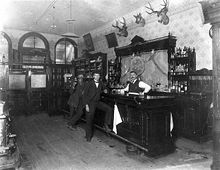
Alcoholic beverages played an important part in the Thirteen Colonies from their early days. For example, the Mayflower shipped more than beer than water when it departed for the New World in 1620. While this may seem strange viewed from the modern context, notation that drinking vino and beer at that fourth dimension was safer than drinking water – which was usually taken from sources also used to dispose of sewage and garbage.[62] Experience showed that information technology was safer to drink alcohol than the typically polluted water in Europe.[ citation needed ] Alcohol was also an effective analgesic, provided free energy necessary for difficult work, and generally enhanced the quality of life.
For hundreds of years the English ancestors of the colonists had consumed beer and ale. Both in England and in the New World, people of both sexes and all ages typically drank beer with their meals. Considering importing a continuing supply of beer was expensive, the early settlers brewed their ain. Withal, it was hard to make the beer they were accepted to because wild yeasts caused problems in fermentation and resulted in a bitter, unappetizing brew. Although wild hops grew in New England, hop seeds were ordered from England in order to cultivate an acceptable supply for traditional beer. In the meantime, the colonists improvised a beer made from red and blackness bandbox twigs boiled in h2o, as well as a ginger beer.

Beer was designated[ by whom? ] X, XX, or XXX according to its alcohol content. The colonists also learned to make a wide variety of wine from fruits. They additionally fabricated wine from such products as flowers, herbs, and even oak leaves. Early on, French vine-growers were brought[ by whom? ] to the New World to teach settlers how to cultivate grapes.

Colonists adhered to the traditional belief that distilled spirits were aqua vitae, or water of life. However, rum was not commonly available until after 1650, when information technology was imported from the Caribbean area. The toll of rum dropped after the colonists began importing molasses and pikestaff sugar directly and distilled their own rum. Past 1657, a rum distillery was operating in Boston. Information technology was highly successful and within a generation the product of rum became colonial New England's largest and most prosperous industry.
Almost every important town from Massachusetts to the Carolinas had a rum distillery to run across the local need, which had increased dramatically. Rum was often enjoyed in mixed drinks, including flip. This was a popular winter beverage made of rum and beer sweetened with sugar and warmed past plunging a cherry-red-hot fireplace poker into the serving mug. Alcohol was viewed positively while its excessive use was condemned. Increment Mather (d. 1723) expressed the mutual view in a sermon confronting drunkenness: "Drink is in itself a proficient brute of God, and to be received with thankfulness, simply the abuse of drink is from Satan; the wine is from God, simply the drunkard is from the Devil."
The United states of America [edit]
In colonial period of America from around 1623, when a Plymouth minister named William Blackstone began distributing apples and flowers, up until the mid-1800s, hard cider was the primary alcoholic drink of the people. Difficult cider was prominent throughout this entire period and null compared in scope or availability. It was one of the few aspects of American culture that all the colonies shared. Settlement along the frontier often included a legal requirement whereby an orchard of mature apple trees bearing fruit within three years of settlement were required before a land championship was officially granted. For case, The Ohio Company required settlers to plant not less than l apple trees and xx peach trees within three years. These plantings would guarantee state titles. In 1767, the average New England family was consuming vii barrels of hard cider annually, which equates to near 35-gallons per person. Around the mid-1800s, newly arrived immigrants from Germany and elsewhere increased beer's popularity, and the temperance motility and continued due west expansion acquired farmers to abandon their cider orchards.[63]
In the early 19th century, Americans had inherited a hearty drinking tradition. Drinking hard liquor was a universally popular occurrence in early on nineteenth-century America.[64] Many types of alcohol were consumed. One reason for this heavy drinking was attributed[ past whom? ] to an glut of corn on the western frontier, which encouraged the widespread production of cheap whiskey. It was at this time that booze became an important function of the American diet.[ citation needed ] In the 1820s, Americans drank seven gallons of alcohol per person annually.[65] [66] [ demand quotation to verify ]
In colonial America, water contamination was common. Two means to ensure that waterborne illness, for example typhoid and cholera, was non conveyed by h2o was to boil it in the process of making tea or coffee, or to use it to make alcohol. As a result, alcohol consumption was much higher in the nineteenth century than information technology is today -- 7.1 Us gallons (27 l) of pure alcohol per person per twelvemonth.[67] Earlier the structure of the Erie Canal, transportation of grain from the west was cost prohibitive; farmers instead converted their grain to alcohol for aircraft eastward. This dependence on booze as a acquirement source led to the Whiskey Rebellion of 1794. Subsequently in the nineteenth century opposition to alcohol grew in the grade of the temperance movement, culminating in Prohibition in the United States from 1920 to 1933.
Run across also [edit]
References [edit]
- ^ WHO Global Status Report on Alcohol 2004 (PDF). Globe Health Arrangement. 2004. ISBN978-92-4-156272-0 . Retrieved 19 March 2015.
- ^ Charles H, Patrick; Durham, NC (1952). Booze, Civilisation, and Club. Knuckles University Printing (reprint edition by AMS Printing, New York, 1970). pp. 26–27. ISBN9780404049065.
- ^ Malhotra, Richa (23 February 2017). "Our Ancestors Were Driinking Alcohol Before They Were Human". BBC News . Retrieved 27 February 2017.
- ^ "'Earth's oldest brewery' found in cave in Israel, say researchers". BBC News. xv September 2018. Retrieved 26 Jan 2021.
- ^ Kahn, Jeffry P. (15 March 2013). "How Beer Gave Us Civilization". The New York Times . Retrieved 17 August 2021.
- ^ McGovern, Patrick East.; Zhang, Juzhong; Tang, Jigen; Zhang, Zhiqing; Hall, Gretchen R.; Moreau, Robert A.; Nuñez, Alberto; Butrym, Eric D.; Richards, Michael P.; Wang, Chen-shan; Cheng, Guangsheng; Zhao, Zhijun; Wang, Changsui (21 December 2004). "Fermented beverages of pre- and proto-historic People's republic of china". Proceedings of the National University of Sciences of the United States of America. 101 (51): 17593–17598. Bibcode:2004PNAS..10117593M. doi:10.1073/pnas.0407921102. PMC539767. PMID 15590771.
- ^ Roach, John. "Thank you! Eight ancient drinks uncorked by scientific discipline". NBC News . Retrieved ix June 2013.
- ^ a b c d eastward f one thousand Gately, Iain (2009). Drink: A Cultural History of Alcohol. New York: Gotham Books. ISBN978-1592404643.
- ^ Chrzan, Janette (2013). Alcohol: Social Drinking in Cultural Context. Routledge. p. xiii. ISBN9780415892490.
- ^ a b "Oldest wine". Guinness World Records . Retrieved 1 January 2019.
- ^ Cavalieri, D; McGovern P.East.; Hartl D.50.; Mortimer R.; Polsinelli Thousand. (2003). "Evidence for S. cerevisiae fermentation in ancient wine" (PDF). Journal of Molecular Evolution. 57 Suppl ane: S226–32. Bibcode:2003JMolE..57S.226C. CiteSeerXten.1.1.628.6396. doi:10.1007/s00239-003-0031-2. PMID 15008419. S2CID 7914033. 15008419. Archived from the original (PDF) on nine Dec 2006. Retrieved 28 January 2007.
- ^ a b "Fermented fruits and vegetables. A global perspective". FAO Agronomical Services Bulletins - 134. Archived from the original on xix January 2007. Retrieved 28 January 2007.
- ^ Dirar, H., (1993), The Indigenous Fermented Foods of the Sudan: A Study in African Food and Nutrition, CAB International, UK
- ^ "Guinness Book of Records declares Georgian wine as world's oldest wine". Georgian Journal. thirty November 2017. Retrieved 1 January 2019.
- ^ "History of Cider". Archived from the original on 12 August 2022. Retrieved 29 October 2022.
- ^ "The Ancient Origins of Apple Cider". eight December 2016. Archived from the original on 22 May 2022.
- ^ "The history and origins of cider". 13 February 2019. Archived from the original on 21 June 2021.
- ^ "The History of Cider". Archived from the original on 29 October 2022. Retrieved 29 October 2022.
- ^ "DiCesare, CR. "Dangers of the 'fifth cup': the Aztec arroyo to booze," Mexicolore, 31 January 2018". Archived from the original on 23 June 2020. Retrieved 23 June 2022.
- ^ McGovern, Patrick East. (2003). Aboriginal Wine: The Search for the Origins of Viniculture. Princeton: Princeton University Press. p. 314. ISBN978-0-691-07080-3.
- ^ a b c d e f chiliad h i j g l m n Preventing Booze Abuse: Booze, Culture, and Command By David J. Hanson folio 3
- ^ a b c Stephen G. Haw (10 September 2012). "Wine, women and poison". Marco Polo in Cathay. Routledge. pp. 147–148. ISBN978-i-134-27542-7.
The earliest possible period seems to be the Eastern Han dynasty... the most likely menses for the starting time of truthful distillation of spirits for drinking in Communist china is during the Jin and Southern Song dynasties
- ^ McGovern, Patrick East. "The Origins and Ancient History of Vino". Penn Museum . Retrieved 19 March 2015.
- ^ Wissler, Clark; Mok, Michel (May 1932). Chocolate-brown, Raymond J. (ed.). "Rock Historic period Had Booze and Prohibition". Popular Science. 120 (5): 44–46, 121–123. ISSN 0161-7370. Retrieved 19 March 2015.
- ^ a b Forbes, Robert James (1970). A curt history of the art of distillation: from the beginnings up to the expiry of Cellier Blumenthal. BRILL. ISBN978-90-04-00617-one . Retrieved 29 June 2010.
- ^ Taylor, F. Sherwood (1945). "The Development of the Still". Register of Scientific discipline. 5 (3): 186. doi:ten.1080/00033794500201451. ISSN 0003-3790.
- ^ Dhawendra Kumar (11 May 2012). Genomics and Health in the Developing Globe. Oxford University Press. p. 1128. ISBN9780199705474.
- ^ Alcohol and Pleasure: A Health Perspective By Stanton Peele, Marcus Grant. Folio number 102. Contributor Stanton Peele, Ph. D., J.D. Published 1999. Psychology Printing. Self/Assistance. 419 pages. ISBN one-58391-015-8
- ^ a b Dasgupta, Amitava (2011). The Science of Drinking: How Booze Affects Your Trunk and Mind . Rowman & Littlefield. p. 3. ISBN978-one-4422-0409-6.
- ^ a b Mathew, Roy J. (18 February 2009). The True Path: Western Science and the Quest for Yoga. Bones Books. p. 131. ISBN978-0738206813.
- ^ Heath, Dwight (1995). International handbook on alcohol and culture . Greenwood Publishing Group. p. 131. ISBN978-0-313-25234-1.
- ^ a b c Irfan Habib (2011), Economical History of Medieval India, 1200–1500, folio 55, Pearson Didactics
- ^ "Full general History of the Things of New Espana by Fray Bernardino de Sahagún: The Florentine Codex – Viewer – World Digital Library". www.wdl.org . Retrieved 7 October 2018.
- ^ Escalante, A.; López Soto, D. R.; Velázquez Gutiérrez, J. E.; Giles-Gómez, Yard.; Bolívar, F.; López-Munguía, A. (2016). "Pulque, a Traditional Mexican Alcoholic Fermented Beverage: Historical, Microbiological, and Technical Aspects". Frontiers in Microbiology. 7: 1026. doi:10.3389/fmicb.2016.01026. PMC4928461. PMID 27446061.
- ^ Henderson, Lucia A. "Blood, Water, Vomit, and Wine: Pulque in Maya and Aztec Conventionalities." Mesoamerican Voices, 3: 53–76, 2008.
- ^ Andrews, Tamra (2000). Nectar & Ambrosia: An Encyclopedia of Food in World Mythology. Santa Barbara, California: ABC-CLIO. ISBN1576070360.
- ^ Rafael Lira, Alejandro Casas, José Blancas, Ethnobotany of Mexico: Interactions of People and Plants in Mesoamerica, Springer, 2016; pp. 116–119.ISBN 1461466695
- ^ La Barre, Weston (1938). "Native American Beers". American Anthropologist. 40 (two): 224–234. doi:ten.1525/aa.1938.xl.ii.02a00040. JSTOR 661862. S2CID 161629883.
- ^ Phantastica, Narcotic and Stimulating Drugs, by Louis Lewin, Due east. P. Dutton & Visitor New York, 1964.
- ^ Valery Havard, "Beverage Plants of the Northward American Indians," Bulletin of the Torrey Botanical Club, Vol. 23, No. 2 (February. 29, 1896), pp. 33–46; Torrey Botanical Society.
- ^ Tamara Stewart, "Ceramic assay indicates fermented beverage was consumed in New Mexico," American Archeology, vol 12 no. 1, leap 2008.
- ^ Theodore Borek, Curtis Mowry and Glenna Dean. "Assay of Modern and Ancient Artifacts for the Presence of Corn Beer; Dynamic Headspace Testing of Pottery Sherds from Mexico and New Mexico." Paper presented at Symposium Y, Materials Issues in Fine art and Archæology Eight, Nov 2007.
- ^ Henderson, J. S.; Joyce, R. A.; Hall, 1000. R.; Hurst, Due west. J.; McGovern, P. Eastward. (2007). "Chemical and archaeological evidence for the primeval cacao beverages". Proceedings of the National University of Sciences. 104 (48): 18937–18940. doi:x.1073/pnas.0708815104. PMC2141886. PMID 18024588.
- ^ "New Chemic Analyses Take Confirmation Dorsum 500 Years and Reveal that the Impetus for Cacao Cultivation was an Alcoholic Beverage". Penn Museum. 2007. Archived from the original on 2 December 2007.
- ^ Tim McNeese, Early American Cultures: The History of North America, Milliken Publishing Visitor, 2002, p. 26. ISBN 0787734098
- ^ James L. Haley, Apaches: A History and Civilisation Portrait. University of Oklahoma Press, 1997, p. 98. ISBN 0806129786
- ^ a b Abbott PJ. "American Indian and Alaska native ancient apply of alcohol in the United States." Am Indian Alaska Native Ment Health Res. 1996;7:1–13.
- ^ Frank, J. Due west.; Moore, R. S.; Ames, G. One thousand. (2000). "Historical and cultural roots of drinking bug among American Indians". American Journal of Public Wellness. 90 (iii): 344–351. doi:10.2105/ajph.xc.3.344. PMC1446168. PMID 10705850.
- ^ a b Cherrington, EH. "Aborigines of Northward America." In E. H. Cherrington (Ed.), Standard Encyclopedia of the Booze Problem, Westerville, OH 1925; Vol I, pp. 3–42.
- ^ Lemert, EM. "Alcohol and the Northwest Declension Indians." University of California Publications in Culture and Lodge vol ii, No. 6. Berkeley, CA: University of California Printing, 1954.
- ^ Ilaria Gozzini Giacosa, A Gustatory modality of Ancient Rome. University of Chicago Printing. 2 May 1994. p. 191. ISBN978-0-226-29032-4.
- ^ Ibeji, Mike (xvi Nov 2012). "Vindolanda". BBC.
- ^ Michael Dietler and Ingrid Herbich, Liquid fabric civilisation: following the flow of beer among the Luo of Kenya, in Grundlegungen. Beiträge zur europäischen und afrikanischen Archäologie für Manfred Thou.H. Eggert, edited by Hans-Peter Wotzka, 2006, pp. 395–408. Tübingen: Francke Verlag. A. Huetz de Lemps, Boissons et civilsations en Afrique, 2001, Bordeaux: Presses Universitaires de Bordeaux.
- ^ "Ka Wai Kau Mai O Maleka Water from America: The Intoxication of the Hawai'ian People," Gimmicky Drug Issues, Summer, 1990:161–194.
- ^ al-Hassan, Ahmad Y. (2009). "Alcohol and the Distillation of Wine in Arabic Sources from the 8th Century". Studies in al-Kimya': Critical Issues in Latin and Arabic Alchemy and Chemical science. Hildesheim: Georg Olms Verlag. pp. 283–298. (same content also available on the author'due south website); cf. Berthelot, Marcellin; Houdas, Octave V. (1893). La Chimie au Moyen Âge. Vol. I–III. Paris: Imprimerie nationale. vol. I, pp. 141, 143.
- ^ Sarton, George (1975). Introduction to the history of science. R. E. Krieger Pub. Co. p. 145.
- ^ Holmyard, Eric John (1957). Abracadabra. Harmondsworth: Penguin Books. ISBN978-0-486-26298-7. pp. 51–52.
- ^ "Distillation". Industrial and Engineering science Chemistry. 28 (half-dozen): 677. 1936. doi:x.1021/ie50318a015.
- ^ Dunn, Rob. "Strong Medicine: Drinking Vino and Beer Can Aid Relieve You from Cholera, Montezuma s Revenge, E. Coli and Ulcers ane". Scientific American Blog Network . Retrieved 27 June 2021.
- ^ "Tom Stevenson (2005) Sotheby's Wine Encyclopaedia Dorling Kindersley ISBN 0-7513-3740-4, p237"
- ^ Wong, Shirley G.Due east.; Fong, Eileen; Tauck, David L.; Kendig, Joan J. (25 June 1997). "Ethanol equally a general coldhearted: Actions in spinal cord". European Journal of Pharmacology. 329 (2–iii): 121–127. doi:ten.1016/S0014-2999(97)89174-i. PMID 9226403.
- ^ "America's History of Drinking". Alcohol.org.
{{cite spider web}}: CS1 maint: url-status (link) - ^ Rutkow, Eric (2012). American Canopy: Trees, Forests, and the Making of a Nation. New York: Scribner. pp. 56–58, 61. ISBN978-i-4391-9354-nine.
- ^ Garrison, James Holley (1954). "Introduction to Part I". In Merrill, Walter McIntosh (ed.). Behold Me One time More. The Confessions of James Holley Garrison, brother of William Lloyd Garrison. Boston: Houghton, Mifflin. p. 4.
- ^ George F. Volition (29 October 2009). "A reality bank check on drug use". Washington Post. pp. A19.
In Waking Giant: America in the Age of Jackson, historian David South. Reynolds writes that in 1820, Americans spent on liquor a sum larger than the federal authorities's budget. By the mid-1820s, annual per capita consumption of accented booze reached seven gallons, more than iii times today's rate.
- ^ Rorabaugh, W.J. (1981). The Alcoholic Commonwealth: An American Tradition. Oxford University Press, USA. ISBN978-0-19-502990-ane.
- ^ Dark-green, Emma (29 June 2015). "Colonial Americans Drank Roughly Three Times as Much every bit Americans Do Now". The Atlantic. Retrieved 6 August 2017.
30.^http://archaeology.nearly.com/od/wterms/qt/wine.htm
Further reading [edit]
- Bert L. Vallee, "Booze in the Western World", Scientific American June 1998
- Michael Dietler, "Alcohol: Archaeological/Anthropological Perspectives", Annual Review of Anthropology 2006, v.35:229–249.
- Jack South. Blocker et al. (eds.): Alcohol and Temperance in History. An International Encyclopedia, Santa Barbara 2003 (esp. on the period afterward 1800, which is non mentioned in this commodity).
- Thomas Hengartner / Christoph M. Merki (eds.): Genussmittel, Frankfort 2001 (esp. the commodity on booze by Hasso Spode).

1 Qt How Many Pints,
Source: https://en.wikipedia.org/wiki/History_of_alcoholic_drinks
Posted by: schneiderbroffely.blogspot.com
0 Response to "1 Qt How Many Pints"
Post a Comment